
Sustainable Agriculture Student Research Project
Effects of biodegradable mulch on dryland riceShannon Campbell, Department of Sustainable Agriculture, 2025 |
Introduction
- Rice is a major food staple across the globe, but it’s traditionally grown in puddled conditions. This production method accounts for 48% of global cropland methane emissions (Qian et al. 2023) and 30% of agricultural freshwater withdrawals (Bouman et al. 2007).
- Dryland rice cultivation requires fewer resources, but it’s challenged by weed competition and reduced yields.
- Biodegradable mulches like paper and straw may help mitigate some of these challenges as a sustainable alternative to puddling.
Objectives
- The goal of this study was to investigate the effect of paper and oat straw mulches on dryland rice cultivation and weed suppression, soil moisture, yield, and mature plant density.
Materials & Methods
Experimental Design
- Randomized complete block design (Fig. 1)
- 4 blocks, 4 plots each (n = 16)
- Each plot was 4 m2
- Treatments are factorial (straw and paper +/-)
- Treatments:
- no mulch (control);
- Oat straw mulch only;
- Paper mulch only; or
- Both mulches (paper layered beneath straw)
- Treatments:
- 4 blocks, 4 plots each (n = 16)
- Rice seedlings were transplanted at the 4-5 leaf stage (~4 weeks old) in late May.
Image

Image

Data Collection
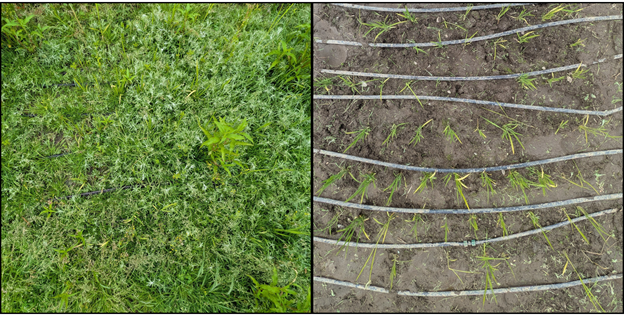
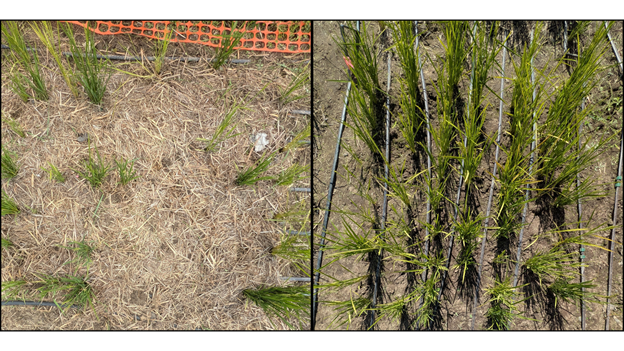
- Plots were hand-weeded in three rounds (May, July, and August); canopy photos taken before and after weeding were compared in the CANOPEO app (Android) at 0.96 sensitivity for weed coverage estimates (Fig. 3).
- Soil moisture was read using a volumetric moisture sensor on multiple dates throughout July, August, and September; daily readings were averaged by plot for comparison.
- Rice grains were harvested and hung to dry in October; seeds were then hand-threshed and mature grains collected using an air separator; final yields were measured for weight.
- Rice density was counted from canopy photos taken after weeding in August.
Image
Statistical Analysis
- A linear mixed model analysis was used for repeated measures of weed suppression (investigating both treatment-round interactions and paper-straw interactions) and soil moisture.
- ANOVA was used for rice density and yield.
Results
- Weed Suppression
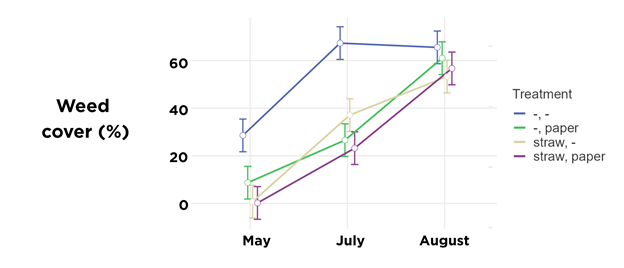
- Mulches suppressed weeds in May and July but not in August (Fig. 4).
- There was an interaction between straw and paper treatments (p=0.039), indicating reduced efficacy when applied together.
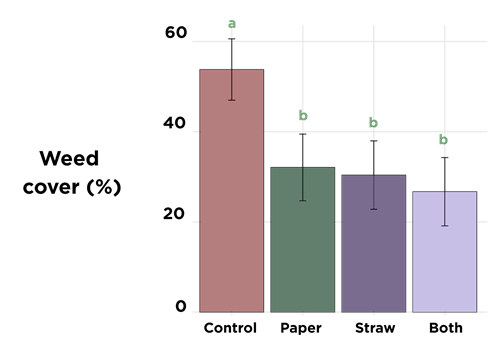
- All mulches were significantly more suppressive vs control (p=0.003 [paper], 0.002 [straw], and <0.001 [both]), but not significant vs each other (Fig. 5)
Image
Image
- Soil Moisture
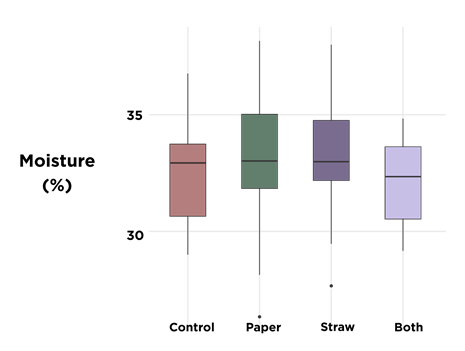
- Mulches had no effect on volumetric soil moisture content versus control (Fig. 6).
Image
- Yield
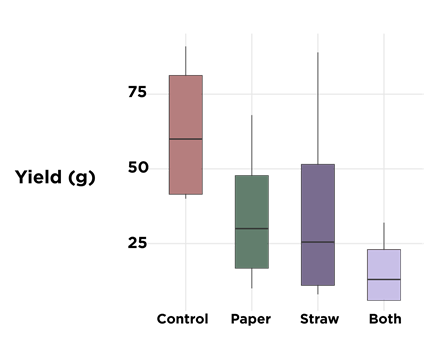
- Mulching had no statistically significant effect on yield (Fig. 7).
- The average yield in double-mulched treatments was less than half that of controls, but this difference was not significant.
- Mulching had no statistically significant effect on yield (Fig. 7).
Image
- Rice Density
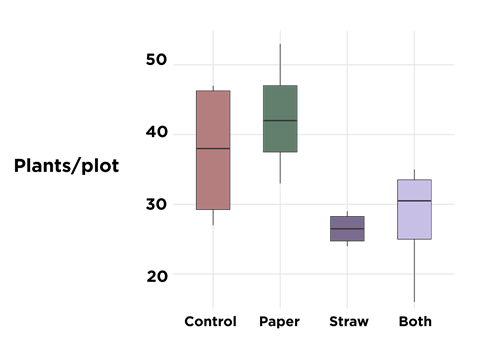
- Plots with straw mulch only had significantly lower plant density at maturity.
Image
Image
Discussion
One Mulch Gets it Done
- All mulching treatments were equally effective against control.
- This means the best solution for a given rice production system is the one that’s easiest (and cheapest) to implement.
- Mulching was most effective at weed suppression early in the season, when transplants were getting established. Although benefits diminished over time, weed competition should present less of a threat once the rice canopy is established.
- Weeds compete for nutrients, but completely removing the weeds from the soil exacerbates soil nutrient depletion.
- Due to wildlife interference, the paper mulch degraded much quicker (<20 days) than the manufacturer’s estimate (~60 days).
- Despite this, the paper mulch fared as well as straw in suppressing weeds–even long after the paper had degraded.
- Securing the paper with the straw on top had no added benefit in weed suppression;
- And doubling up the mulches led to numerical lower mean yields.
Wet Soils
- Soil moisture levels remained high all summer long, but this was also likely due to wildlife intervention; coyotes punctured the irrigation lines regularly.
Yields Unaffected… Mostly
- Mulching had no significant effect on yield.
- This is possibly because the weeds were periodically removed, reducing observable impacts of weed competition over the season.
- There was no significant difference between the yields in paper-only and straw-only treatments, despite straw-only treatments having significantly lower plant density at harvest.
- Overall, yield densities were low compared to industry standards.
Table 1. Yield estimates adjusted to kg/ha from experimental treatments (first four rows) to commercial growers in Abbotsford (Masataka Shiroki, email to author, 27 November 2025) and the USA (Thomet 2017) (both grown in puddled conditions).
| Treatment | Yield (kg/ha) |
| Straw mulch | 370 |
| Paper mulch | 346 |
| Both mulches | 160 |
| Control (no mulch) | 628 |
| Abbotsford (Puddled, 2025) | 1,483 |
| US National average (Puddled) | 8,967 |
Conclusion
- Both straw and paper biodegradable mulches significantly suppressed weeds compared to the control;
- A significant interaction was observed between the straw and paper mulches, indicating no added benefit to double mulching for weed suppression.
- No treatment had a significant effect on rice yield or soil moisture.
- Numerical mean yields were lower in double mulched treatments compared to the control, warranting further investigation into possible trade-offs.
- Mature plant density was significantly lower in straw mulch.
- Despite this, mean yields in straw and paper mulches were not significantly different.
References
- Bouman BAM, Lampayan RM, Tuong TP. 2007. Water management in irrigated rice: coping with water scarcity. Los Baños (Philippines): International Rice Research Institute.
- Thomet H. Exploring dryland rice production in the mid-Atlantic. 2017 Jan 26. Newburg (MD): Next Step Produce; Northeast SARE. Final Report for FNE15-832. Available from: https://projects.sare.org/project-reports/fne15-832/
- Qian H, Zhu X, Huang S, et al. 2023. Greenhouse gas emissions and mitigation in rice agriculture. Nat Rev Earth Environ 4(11):716–732. doi:10.1038/s43017-023-00482-1.
Acknowledgments
Thank you to Mike Bomford, Rebecca Harbut, and Sahar Zandieh for their guidance and support. Special thanks to Masa Shiroki and Akio Nakamura of Osake Craft Distillery for their generous contributions and mentorship.
Image
- Thank you to Dillon MacPherson, Akshay Balakrishnan, Em Guiry, Kris Ruff-Frederikson, Anupjot Badesha, Elyse Farmer, Isbah Mahmood, and Isaac Hendrickson for their moral support and manual labour.