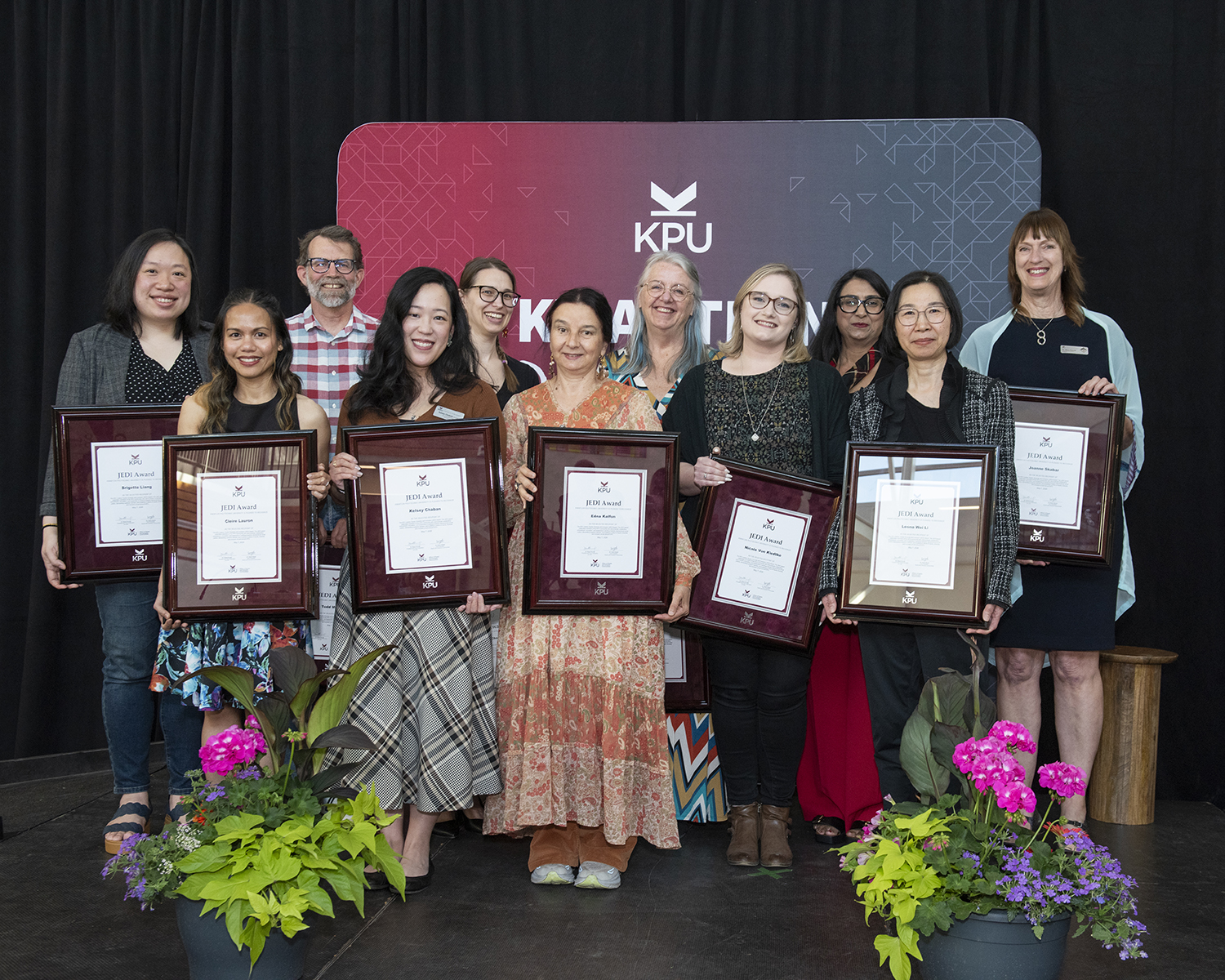
A KPU Library team whose efforts toward Indigenization, anti-racism and equity is being celebrated for making a positive impact at the university.
Their work — implementing the Brian Deer classification system, supporting Indigenous-owned vendors and authors, updating First Nations names in the library catalogue and creating innovative Indigenous-focused learning spaces that strengthens community connection and belonging — has earned the KPU Library χʷəχʷéy̓əm team a 2026 JEDI Award.
The Justice, Equity, Diversity and Inclusion (JEDI) Awards, presented annually by the Office of Equity and Inclusive Communities, celebrate members of the KPU community who demonstrate outstanding commitment, innovation and leadership in working towards intersectional social justice, dismantling systemic barriers and building a culture of equity, diversity and inclusion at and around the university.
“We are grateful for the library team and all the committed individuals who have worked hard to advance Indigenization and reconciliation efforts at KPU. On behalf of the OEIC, I would like to congratulate them on receiving the JEDI award and commend their dedication to fostering meaningful change across our institution,” says Dr. Asma Sayed, Vice-President, Equity and Inclusive Communities at KPU.
χʷəχʷéy̓əm team members include: Rachel Chong, Indigenous Initiatives Librarian; Todd Mundle, University Librarian; Cleire Lauron, Metadata and Discovery Librarian; Edna Kalfon, Library Technician; Brigette Liang, Cataloguing & Metadata Technician; Joanne Skabar, Library Assistant, Indigenous and IDEA; Kelsey Chaban, Librarian and Archivist; Leona Wei Li, Acquisitions Serials Technician; Judy Taylor, Coordinator Technical Services; and Nicole Von Kledtke, Acquisitions Cataloguing Tech.
“We’ve been doing this work for some time, and it’s especially meaningful to receive this recognition as a team,” says Chong. “It highlights how essential collaboration is. Real progress depends on everyone working together, both to create change in the moment and to ensure it lasts. This recognition also reflects KPU’s leadership in advancing these initiatives within the post-secondary sector.”
χʷəχʷéy̓əm means oral storytelling in hən̓q̓əmin̓əm̓, the language of the Kwantlen, Katzie, Tsawwassen, Kwikwetlem and Musqueam first nations on whose traditional territories KPU is built.
“This work is part of being good relatives and neighbours. It’s about creating welcoming, positive learning spaces and repairing relationships within education. For First Nations People, who were once excluded from post-secondary institutions, Indigenization of university library practices is an important part of Truth and Reconciliation,” says Chong.
Indigenization at KPU Library is a key goal in its 2025-2027 strategic plan. Among its commitments is reconciliation — by dismantling “colonial approaches while amplifying Indigenous ways within library services, collections, spaces and outreach.”
An example of this is the χʷəχʷéy̓əm Indigenous Collection — a resource space and collection located in all four campus libraries. The collection features material by Indigenous authors that underscores the importance of Indigenous Peoples telling their own stories. Circular shelves emphasize the importance of circle learning and sharing, and seating showcases KPU alum Jennifer Lamont’s vibrant design of a pow wow dancer surrounded by a floral motif.
All materials in the χʷəχʷéy̓əm Indigenous Collection have been organized with a localized version of an Indigenous classification system from Brian Deer — a Kahnawake Mohawk Librarian who developed the first Indigenous library classification system in Canada in the 1970s.
“I’m particularly proud of our work with the Brian Deer classification system, which has generated strong interest across the library community. We’ve presented at conferences and continue to receive inquiries from across the country. I’m also proud of the collaboration within the university to showcase the beautiful upholstery from an Indigenous student that is used on the seating in the χʷəχʷéy̓əm spaces,” says Chong.
KPU Library also created a series of instructional videos on using or sharing Indigenous information in research. The videos cover topics such as respectful research practices, how to cite Elders and Knowledge Keepers and how to evaluate Indigenous sources.
More recently, the library launched an Indigenous Oral Stories Series to expand student opportunities to learn from Indigenous Elders.


