When looking at post-secondary options, it’s often the choice between trades and undergraduate, and it’s not usually a comparison of equal esteem. But it doesn’t have to be that way and KPU is leading that charge. In May 2026, KPU had an opportunity to address that issue at Polytechnics Canada’s Polytechnics: Canada’s Innovation Partners conference.

Laura McDonald, Dean of Trades and Technology at KPU, and Provost & VP Academic pro tem, Dr. David Burns, presented a session titled Parity of Esteem Between Trades and Business: Building Pathways for Students to a crowd of Canada’s top institutions, addressing an issue that polytechnics are uniquely positioned to help solve.
“The title of the presentation is meant to acknowledge the rigour associated with vocational education, societal perceptions of the skilled trades, and ideally a way to increase interest and participation within the industry,” McDonald says.
There is a level of reluctance amongst Canadian youth when considering the trades, according to an Employment and Social Development Canada study. Couple that with a shortage of skilled trades workers and an aging working population, it’s easy to see the opportunity that’s obscured through years of systemically ingrained bias.
“The division between trades and ‘academic’ thinking is a very old division in Western culture and, in some senses, Western philosophy,” explains Burns. “Knowledge, in everyday terms, is often seen as being divided between a universal kind of knowledge (as in empirical science or philosophy) and knowledge of how something is, or can be, done.” Traces of this, he argues, can be seen at least as far back as Aristotle.
While it is clear that these ideas have been present in Western thought for a very long time, this doesn’t justify the ways in which contemporary academic systems privilege disciplines associated with “academic” knowledge over those associated with trades, craft, and vocational learning. It doesn’t, in other words, explain the lack of esteem.
“The phrase ‘parity of esteem’ gained traction in educational settings in reference to the perception of a second-class educational pathway for technical and vocational education and training (TVET),” says McDonald. “Embracing parity of esteem intra-institutionally will allow us to support students in embarking upon a holistic educational journey which includes bridging from vocational to undergraduate and from undergraduate to vocational.”
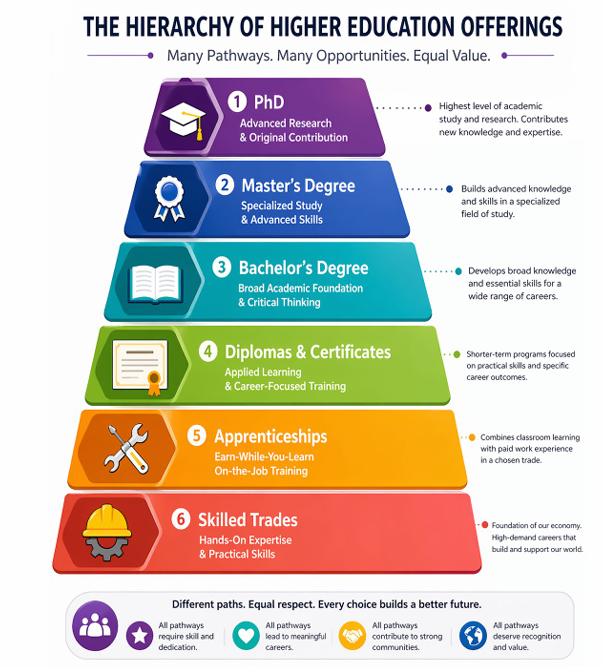
To accomplish this, institutions need to focus on connecting trades/vocational programs with undergraduate programs, removing unfair language from policies that make the skilled trades seem less important, and focusing on supporting alternative paths to good careers.
KPU is already removing references to ‘laddering’ from trades to undergraduate programs, instead replacing it with ‘bridging’ to remove the perception of trades being of lower esteem than academia. But it goes beyond just what language is being used.
“It’s not about applying undergraduate credits to vocational programs, it’s about acknowledging the different yet equal educational pathways,” says McDonald. “We have already built a Prior Learning Assessment & Recognition (PLAR) bridge between vocational and undergraduate through the assignment of credits, and I envision continuing to expand upon this foundational work.”
“Specific to the Melville School of Business, I have been working with some of their departments to consider Red Seal certification as a potential admission requirement for the post-baccalaureate programs. The Operations and Supply Chain Management admission requirements are currently working their way through institutional governance to give final approval of accepting Red Seal certification as an admission requirement. This is a very exciting step toward parity of esteem at KPU.”
McDonald outlines potential next steps in the process at KPU that include additional post-baccalaureate diplomas, advanced entrance into upper-division courses and programs via admission criteria, prerequisite consideration, and automated Prior Learning Assessment & Recognition streams.
Moving towards true parity of esteem is in the early stages, but McDonald and Burns were keen to push for institutions to follow KPU’s lead and start taking the necessary steps to overcome the bias against vocational education at a time when it needs to be valued more than ever.
“The event was very interesting and impactful,” says McDonald. “Having the opportunity to listen but also connect with representatives from institutions and industry from across Canada was hugely valuable. I really enjoyed sharing the stage with Dr. Burns. Our foundational knowledge and perspectives complemented each other, creating an engaging and thought-provoking presentation for the audience.”


