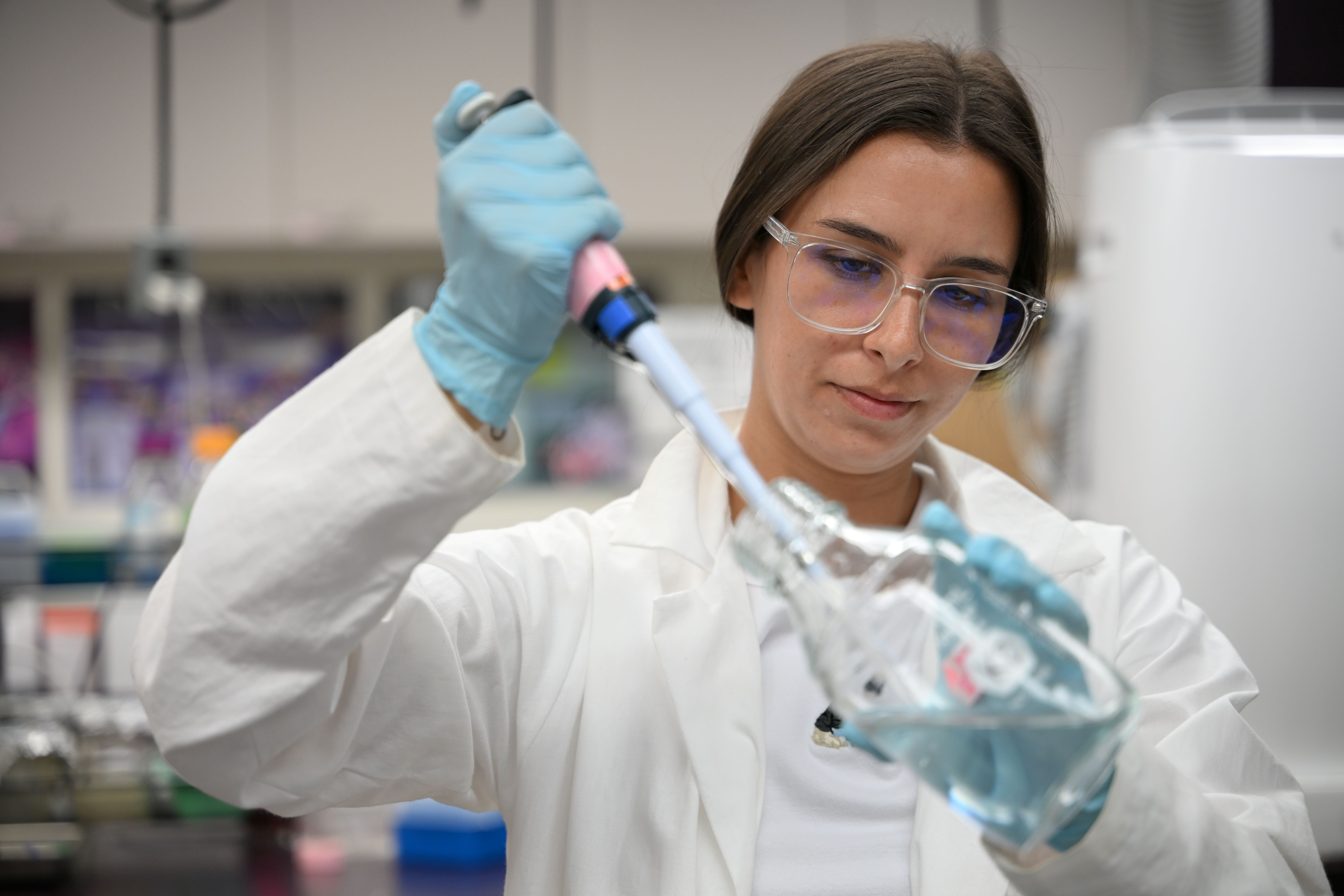
Mice and rats have long been favoured by scientists for biomedical testing, but a new method from a Kwantlen Polytechnic University (KPU) researcher is worming its way to the surface.
Dr. Kelsie Doering, a biology instructor and researcher at KPU’s Applied Genomics Centre (AGC), supported by Genome BC, is deploying tiny roundworms to test the safety of new pharmaceutical and agricultural products. Using these worms — known as Caenorhabditis elegans, or C. elegans — Doering is developing a toxicity testing toolkit in her lab on the Richmond campus, without the need for long-tailed rodents.
“Toxicity testing is required to determine the impacts of pharmaceuticals and pesticides on human health and the environment to ensure safety,” she says. “There’s been a recent push to limit rodent use in toxicity testing, and C. elegans present a unique opportunity to optimize our ability to perform tests for industry and government partners in an ethical, cost effective and highly efficient way.”
C. elegans are tiny nematode worms that have a lifecycle of three days and a lifespan of approximately three weeks. Mice, by comparison, have a lifecycle of two months and a lifespan of up to three years.
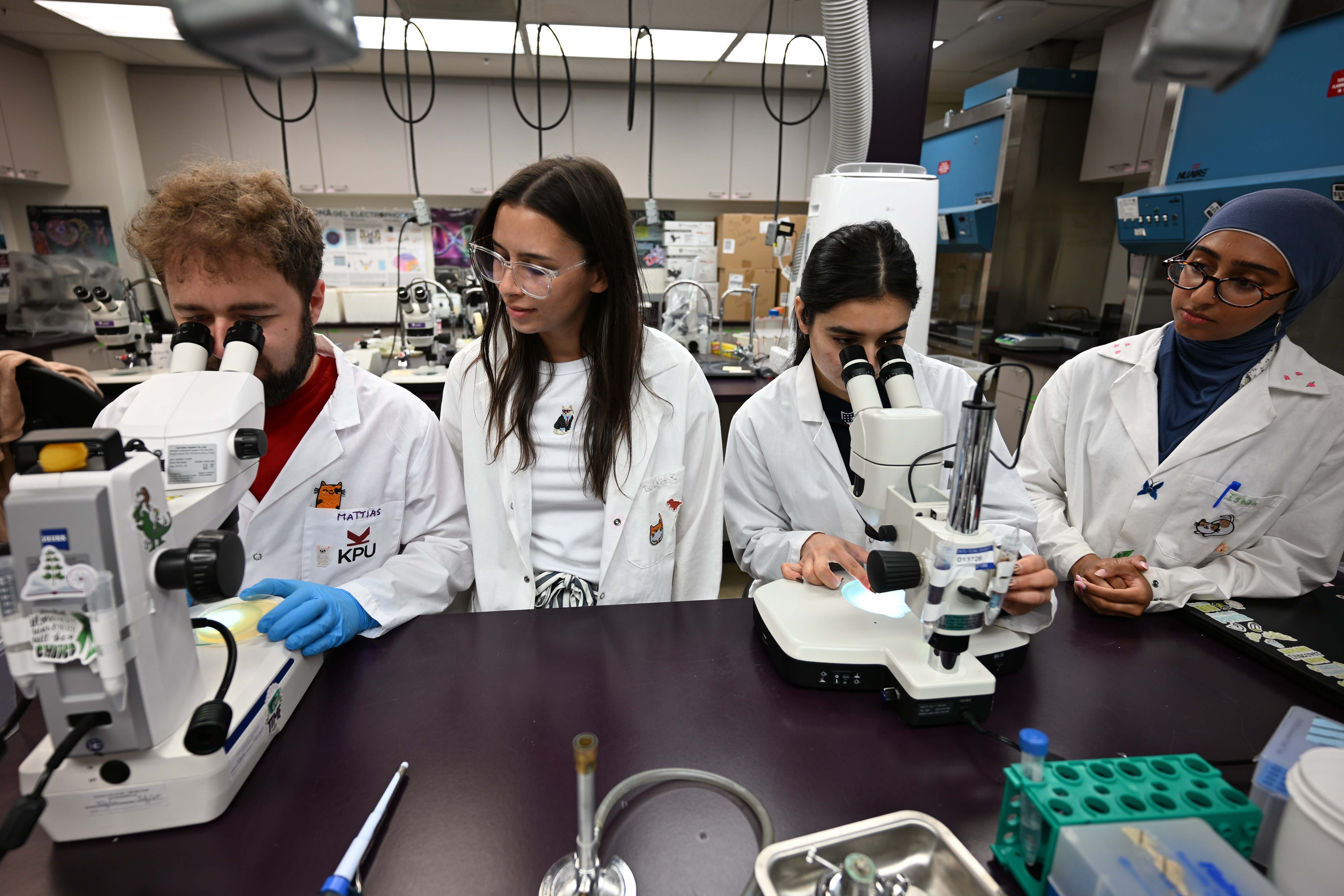
“These microscopic transparent nematodes only live for a few weeks, and very importantly are not toxic, not pathogenic, not infectious. So not only are they really efficient for use, but they are also very safe for research.”
The worms are small enough to grow on simple Petri dishes, making them significantly cheaper to breed and care for in the lab.
“Most people understand the biggest advantage of using rodents to be their similarities to humans as mammals, yet C. elegans have a surprisingly high homology to human genes, especially in the biological systems that help cells respond to and cope with stress, where they share approximately 70 per cent of their genes with us,” says Doering. “This is super important as the things we learn in the worm can be applied to human biology.”

Another advantage for researchers is that experiments with these tiny worms do not require ethics approvals.
Toxicity testing in particular is also more efficient. The worms don’t have a circulatory system, so any substance being tested can easily be delivered to their cells, and because of how small and fast they are, scientists can quickly test different concentrations and drug combinations. And for agricultural product testing that requires evaluating what a chemical is doing to the soil, the worms are prime test subjects as they live in soil.
Doering and her students are now putting their systems to the test by collaborating with Pan-Biome Pharmaceuticals to evaluate a newly-developed drug, and early results are promising. Once the testing toolkit has been refined, the researchers aim to work with other partners to evaluate the safety of new compounds.
“The idea is that if an industry partner has a new agricultural or pharmaceutical product, we would be able to perform a suite of toxicity tests in order to deliver them very valuable toxicity information,” she says. “Ultimately we’d like to see it become a widely used screening platform that helps researchers make better-informed decisions earlier in product development.”
Doering says the project, which is funded by grants from the Natural Sciences and Engineering Research Council of Canada (NSERC) and Genome BC, has provided plenty of research opportunities to KPU students. Everything from literature review and optimizing protocols to experiments and data analysis is being conducted by student researchers.
“This work would not be possible without our amazing student researchers, who in return get the invaluable experience of working on these projects. Providing these opportunities to both students and partners is something I am extremely proud of, and something that I hope to continue to do.”
The Applied Genomics Centre is Canada’s first Technology Access Centre (TAC) focused on applied research and development using genomic tools to support the agri-tech sector.


