
What does justice look like when the goal is not punishment, but healing, accountability and stronger relationships?
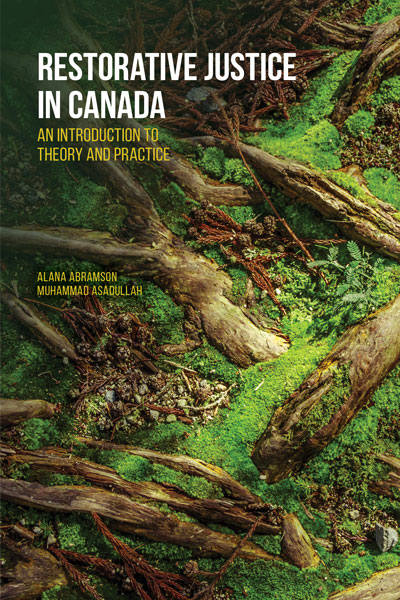
That question is at the heart of Restorative Justice in Canada: An Introduction to Theory and Practice, a new textbook by Dr. Alana Abramson, a criminology instructor at KPU. Drawing on her experience as a researcher, educator and restorative justice practitioner, Alana's book introduces students to the values, principles and applications of restorative justice in communities across Canada.
The book, co-authored by Muhammad Asadullah, explores how restorative approaches are used in settings ranging from schools and post-secondary institutions to community organizations and the criminal legal system.
Abramson says she wanted to create a Canadian textbook that provided students with a strong foundation in the theory and practice of restorative justice while also creating opportunities for the kind of learning she’s witnessed in her research. Throughout the book, students encounter stories and perspectives of victims and survivors, people who have caused harm, practitioners, educators and community members.
The book ultimately speaks to restorative justice as more than an alternative response to crime. Abramson hopes it encourages students to think differently about harm, accountability, relationships and our obligations to one another — and perhaps to examine some of their own assumptions along the way.
What led you to write the book?
“I’ve been working in restorative justice for many years, both as a practitioner and an educator, and one of the things I kept noticing was the gap between how restorative justice is often described academically and how it is actually experienced by people. Restorative justice is fundamentally relational, but it can become quite abstract when we reduce it to definitions, models and processes.
“My doctoral research reinforced this for me. I studied what happens when restorative justice is taught experientially in a university classroom, and found that students’ learning could extend well beyond simply acquiring knowledge about restorative justice. For many students, engaging with stories, practitioners, dialogue and restorative processes challenged existing assumptions and changed how they understood justice, other people, and even themselves. Some carried those changes into their relationships, their professional aspirations, and the way they approached conflict and harm. That research convinced me that how we teach restorative justice matters as much as what we teach about it.”
Why does restorative justice matter, and why is now an important time to engage with it?
“We live in a time when responses to harm can become very polarized. There can be enormous pressure to decide who is right and wrong, assign blame, punish someone, and move on. Restorative justice asks us to do something much more difficult: to remain accountable for harm while also recognizing complexity and humanity.
“That does not mean minimizing harm or avoiding consequences. In fact, restorative justice can demand a much more active form of accountability. It asks people to understand the impact of their actions, listen to those who have been affected, take responsibility, and participate in repairing harm where repair is possible. At the same time, it asks systems and communities to examine the conditions in which harm occurs and their own responsibilities for creating safer and healthier relationships. This discussion of individual and collective accountability is critical at this time.
“I think this is particularly important for students because they are going into workplaces and communities where they will encounter conflict, harm and difficult conversations regardless of their profession. Restorative justice gives them another way of thinking about how we respond in those moments. It has applications well beyond the criminal legal system — in schools, universities, workplaces, families and communities. Ultimately, it offers a framework for thinking about how we want to live together when relationships become difficult or harm occurs.”
You’ve worked in restorative justice for many years. How did your experiences influence the book?
“My experiences influenced virtually every part of the book. I’ve had the privilege of learning about restorative justice from practitioners, students, victims and survivors, people who have caused serious harm, incarcerated and formerly incarcerated people, Indigenous knowledge holders and many others. Those relationships have continually complicated and deepened my understanding of what restorative justice means.
“They have also taught me that the most powerful learning often happens through story. Someone can understand a restorative justice principle intellectually, but hearing a person describe what it meant to sit across from someone who harmed them, to finally have questions answered, to take responsibility for something they have done, or to be seen as a human being rather than only through the worst thing they have experienced or done — that changes the conversation.
“That is why storytelling became so important in the book. We deliberately included real experiences, cases and perspectives alongside the research and theory. We also wanted to be transparent about the complexities of restorative justice. It is not appropriate in every circumstance, it is not automatically safe simply because it is called ‘restorative,’ and it requires careful attention to power, trauma, culture, preparation and the needs of people affected by harm.
“After all these years, I think my practice has actually made me less interested in presenting restorative justice as a simple solution and more interested in the questions it asks us to wrestle with. I wanted the book to invite students into those questions rather than simply tell them what restorative justice is.”


