
That feeling something is incomplete or not quite right can be distressing, especially for people with obsessive-compulsive traits.
Not only are such situations uncomfortable, they may also interfere with certain types of thinking and attention, according to new research from Kwantlen Polytechnic University (KPU).
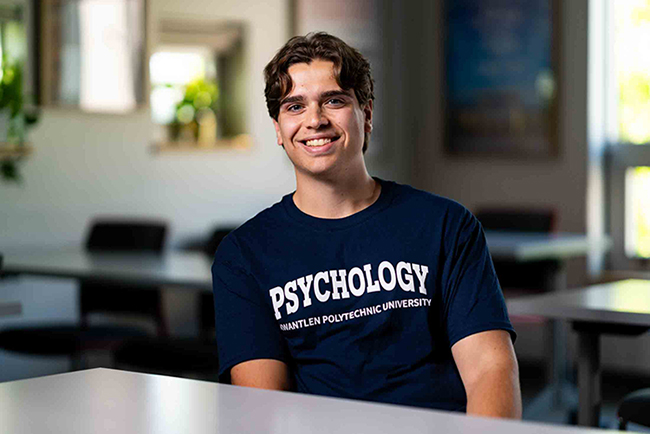
A study by KPU psychology honours graduate Aidan Sammel found people with obsessive-compulsive traits who experience more intense so-called Not Just Right Experiences may have greater difficulty switching between tasks — an executive functioning skill involved in shifting attention and adapting to changing demands.
Not Just Right Experiences frequently occur in conditions such as obsessive-compulsive disorder (OCD) and vary widely, from experiencing mental discomfort upon seeing a picture hanging crooked, to feeling the need to walk on an even number of sidewalk cracks.
“When someone is having a Not Just Right Experience, part of their attention may become focused on resolving that feeling of incompleteness, leaving fewer cognitive resources available for other tasks,” says Sammel, who led the study under KPU psychology instructor Dr. Daniel Bernstein.
Previous research has shown that people with obsessive-compulsive tendencies can experience greater difficulty with mental skills needed to carry out day-to-day tasks, such as problem-solving, reasoning, planning and self-control. But Sammel specifically investigated the potential role Not Just Right Experiences might have.
“Most people experience these feelings occasionally, but for people with OCD these experiences can become more intense, more distressing and harder to ignore,” says Sammel, whose study, “Not-just-right experiences link obsessive-compulsive tendencies and executive dysfunction,” is published in the Journal of Behavioral and Cognitive Therapy.
Two experiments were conducted. Participants were exposed to either a Not Just Right Experience — a picture of a messy room, abruptly removed — or a control condition. Next they completed cognitive tasks measuring executive functioning and a questionnaire on OCD tendencies.

Across both experiments, individuals with higher obsessive-compulsive traits who also reported stronger Not Just Right Experiences performed worse on set-shifting tasks.
According to the study, Not Just Right Experiences may interfere with cognition because people feel compelled to resolve the feeling that something is incomplete or not right. This may disrupt attention and make it harder to shift focus between tasks. The findings suggest that Not Just Right Experiences may help explain why some people with obsessive-compulsive traits experience difficulties with certain cognitive tasks.
“We’re adding to the understanding of obsessive-compulsive tendencies, which can be very disabling. The more we understand how these experiences interfere with thinking and behaviour, the better we can understand the mechanisms that may contribute to symptoms and difficulties in everyday life.” says Sammel.
“People with OCD often blame themselves when they have trouble focusing, switching tasks, or moving on from something that feels unfinished. Our findings suggest these experiences may not simply reflect a lack of effort or ability. Sometimes the feeling that something is ‘not right’ may itself be consuming mental resources.”
The research suggests treatments could potentially be improved by more directly considering feelings of incompleteness, particularly among individuals whose symptoms are strongly driven by these experiences.
“We hope that this work ultimately improves the lives of people who struggle with obsessive-compulsive tendencies,” says Dr. Bernstein, KPU Research Chair in Lifespan Cognition.
Sammel says the research may also help build awareness.
“Many people don’t realize that OCD is not only about contamination fears or checking behaviours, but also these subtle feelings that something is unfinished, incomplete or just not right. By highlighting this, our project helps increase awareness and may point toward more target approaches to support,” he says.
Sammel says KPU gave him an incredible opportunity to pursue research, which was supported by a Student Research and Innovation Grant.
“Working with Dr. Bernstein gave me the chance to take a research project from idea to publication while receiving dedicated one-on-one mentorship, support, and guidance from someone with extensive expertise in the field throughout the entire process.”
Bernstein noted that undergraduate research serves both students and faculty.
“KPU provides unique and exciting opportunities for undergraduate students to work closely with faculty on research. Students and faculty alike benefit from this partnership.”


