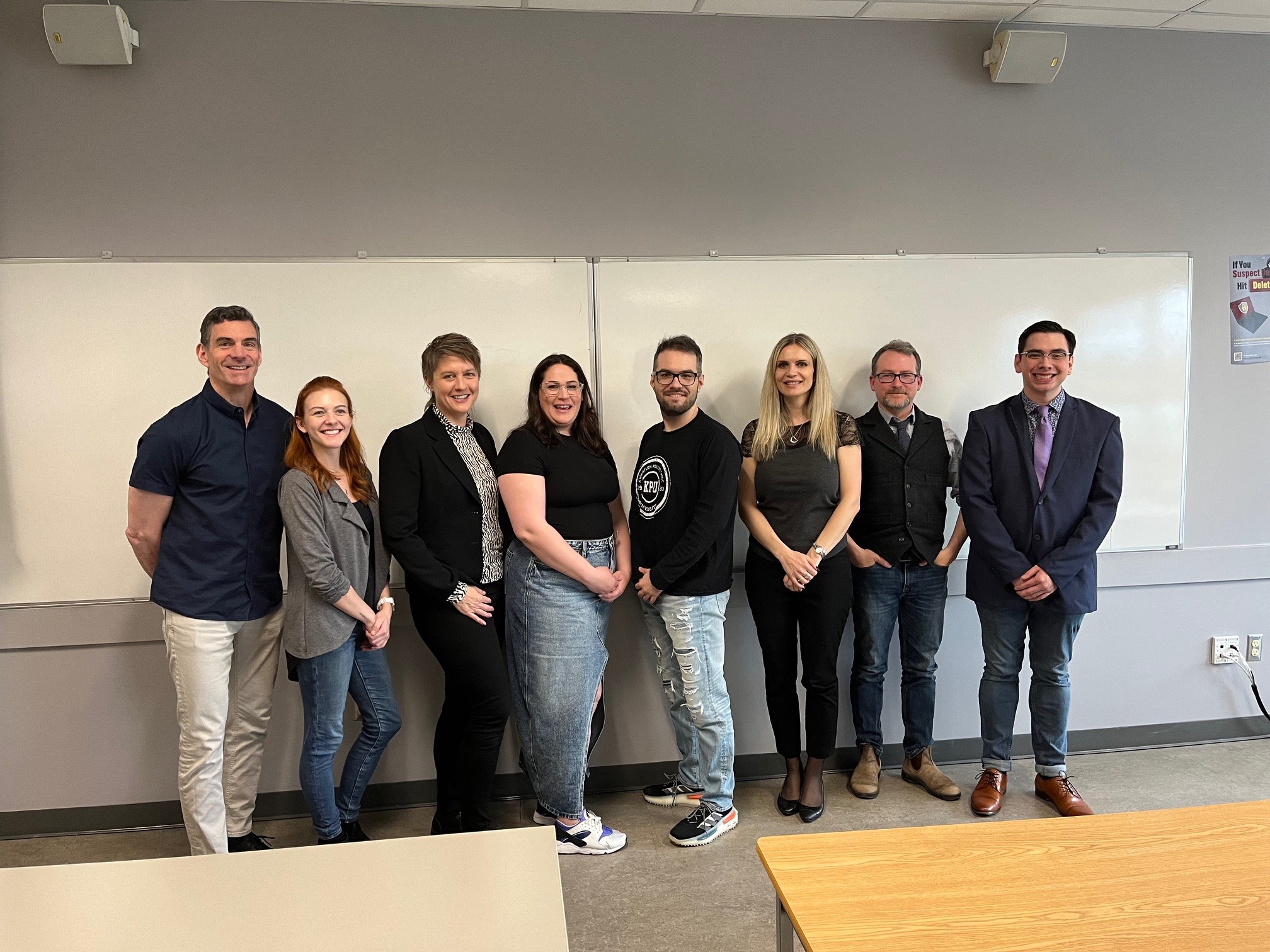
Program Overview
The Criminology Honours Program is a research-focused program that guides students through all phases of an original research project. Students prepare a written thesis, and their time in the program culminates in a public presentation (defense) of their thesis project. The Honours program is an important opportunity for students interested in grad school, law school, a career in research, or simply gaining an in-depth understanding of an agency or institution at which they wish to be employed.
The Honours program consists of three separate but related courses: CRIM 4970, CRIM 4990, and CRIM 4995. In the Fall semester, students enroll in CRIM 4970, a weekly in-person seminar, alongside other Criminology Honours students. Students also take CRIM 4990 in the Fall, which is led by the student’s Honours supervisor and in which students prepare a literature review and design a research plan for their project. At the end of the Fall semester, students present a proposal for how they plan to conduct their research project. In the Spring semester, under the guidance of their Honours supervisor, students complete CRIM 4995 in which they collect, analyze, and present the findings of their original research project as a written thesis and public presentation.
Prerequisites to Apply
Declaring into the BA Honours, Major in Criminology requires the permission of the Criminology Honours committee. Students must normally:
- Have completed 60 credits or more at the time of application
- Achieve a CGPA of 3.5
- Have completed CRIM 3104
Application to 2027/2028 KPU Criminology Honours Cohort
All students who are accepted into the Criminology Honours Program begin the program in Fall. However, there are three application deadlines every year, one per semester, shortly after which applications are considered by the Honours Committee. Applying early can help increase your chances of being accepted into the program, because it is limited to a maximum of ten students.
Apply by completing the form at the bottom of the page.
The application deadlines for the 2027/2028 Honours cohort are:
- Fall Semester: Friday, December 18th, 2026
- Spring Semester: Friday, April 30th, 2027
- Summer Semester: Friday, July 3rd, 2027
Honours Thesis Supervisors and Research Interests
Students who enroll in the Honours program are supervised by a Criminology faculty member. When selecting a supervisor, it is best to work with one whose research interests overlap with your proposed research thesis topic. If you do not have a supervisor in mind prior to applying, the Honours Committee can help you to find one. However, it can be useful to consider who is willing to supervise projects and what topics they are willing to oversee when deciding if the Honours program is right for you. Please see below for faculty who are interested in Honours supervision for the 2026/2027 academic year and what their research interests are.
Faculty Name | General Areas of Research Interest | Methodological Preference | Topics of Past Supervised Projects |
|
|
|
|
Abramson, Alana
| Restorative justice, corrections, community corrections, prison justice, trauma-informed approaches, transformative justice, community justice | Qualitative | Restorative justice education and public school, impact of restorative justice in cases of serious and violent crime, establishment of a Prisoner's Helpline |
Ashton, Stephanie
| Intimate partner violence, sexualized violence, policing in all contexts | Qualitative or quantitative | Strangulation investigation in intimate partner violence, Black women's experience with Law enforcement |
Bhayani, Galib
| Police ethics, police training, police and mental health, use of hub tables, international policing and peacekeeping | Qualitative or quantitative |
|
Boydell, Carroll
| Whistleblowing, informants, deception detection, eyewitness memory | Qualitative or quantitative | Teaching, policy, and generative artificial intelligence |
Goelman, Ari
| Community and crime, urban crime, crime and built form | Qualitative or quantitative |
|
Hassan, Shereen
| Open to supervising a wide variety of topics using qualitative research methodology | Qualitative | Racial profiling, evaluation of gang prevention program, gender on children's books, non-consensual distribution of intimate images |
Hirschmann, Paula
| Open to supervising a wide variety of topics, but especially those within green criminology and issues of gender-based violence and with strong theoretical focus (e.g., social theory, criminological theory, meta-theory) and/or employing content analyses | Qualitative or quantitative |
|
Jonas, Petra
| Juvenile justice, women, crime and justice and social media, cyberbullying and other forms of online victimization | Qualitative or quantitative | Gendered workplace harms, evolution of teaching and learning in criminology post-pandemic, shifting representations of women in crime media, online hate in gaming, hate against international students, intersectional experiences of fear and well-being, trauma faced by youth in group homes in British Columbia |
Lyons, Tara | Topics at the intersection of criminalization and health, such as gender, sexuality, substance use, sex work, and social justice. | Qualitative or quantitative | Arts-based prison programs, femicide, child apprehension, experiences of KPU students, 2SLGBTQIA+ communities, Surrey Union of Drug Users, Walk With Me at KPU |
Mangat, Sunny
| Gender-based violence, sexual violence, youth gangs (specifically South Asian), law enforcement (policing) | Qualitative |
|
Meyers, Jeffrey
| Constitutional law, jurisprudence, legal theory, rule of law, comparative law; law and literature, American law, law and politics, constitutional theory, social contract, critical theory, cultural theory, postcolonial theory, law and communications, legal history | Qualitative | Legal misinformation/disinformation re: COVID-19 pandemic shaping views of public health regulations around masking and vaccination as violations of Charter rights, Trumpism and the decline of the Rule of Law, interdisciplinary application of theory to interrogate legal and constitutional questions |
Murphy, Josh | Policing and public safety, communities and crime, community health and well-being | Qualitative | The use of social media - specifically Facebook community groups - as a crime prevention and community safety tool |
Simmons, Greg
| Green criminology and crimes against the environment, corporate crime, white-collar crime, state-corporate crime, critical criminology | Qualitative or quantitative | Helping professionals in social services, working conditions for independent contractors of food-app delivery companies, intersubjectivities and invariances of conflict among criminology instructors, use of cult-like recruitment tactics within beauty based multi-level marketing companies, employee discourse of complaint processes in non-profit organizations, deferred prosecution agreements in Canada |
Vardy, Mark
| Green criminology, climate change, science and technology studies, green cultural criminology | Qualitative | Rewilding in urban spaces |
Honours Application Checklist:
o A 250-300 word statement of interest that includes:
o why you are interested in the Honours program
o a brief description of the area of research interest
o a brief discussion of the proposed research method(s)
o the name of preferred supervisor, if you have one. The Honours Committee will support you in finding a supervisor for your project if necessary.
o A current copy of your unofficial transcript
o (If applicable) A brief explanation of requirements that have not yet been completed, and an outline of a plan to complete them before Fall 2026.
o (If CGPA is < 3.5) Please provide a brief explanation of your CGPA. For example, you can include any disruptions, impacts of COVID-19, family responsibilities, etc. that have impacted your grades.
o The number of credits you will have completed by September 1, 2026
o (If applicable) A brief explanation of requirements that have not yet been completed, and an outline of a plan to complete them before Fall 2026.
Please fill out the application form.