
Restorative Justice at KPU
Restorative justice at Kwantlen Polytechnic University (KPU) reflects the institution’s commitment to community, accountability, and relational approaches to harm and conflict. Grounded in Indigenous and decolonial principles, restorative justice at KPU emphasizes dialogue, empathy, and healing rather than punishment – fostering learning environments that prioritize mutual respect and responsibility.
For more than 10 years, KPU has been engaged in developing restorative justice approaches to respond to and prevent academic and non-academic harm, including breaches to academic integrity and student conduct. These efforts align with KPU’s broader vision of transformative education that bridges academic inquiry with real-world applications in justice, reconciliation, and community well-being.
Message from Diane Purvey, Acting President

At Kwantlen Polytechnic University, we are committed to fostering a learning environment grounded in respect, accountability, and care for one another. Restorative justice reflects these commitments by offering thoughtful, relational approaches to addressing harm, conflict, and challenges such as academic integrity and student conduct.
I encourage you to explore KPU’s Restorative Justice website to learn more about what restorative justice is, how it is being used at KPU, and the ways it can support learning, healing, and stronger community connections. Whether you are a student, faculty, or staff member, this resource offers valuable insights into how we can respond to harm in ways that uphold dignity, responsibility, and growth.
I invite you to take some time to explore the site and consider how restorative approaches can contribute to a more connected and supportive KPU community. If you are interested in learning more, feel free to reach out directly to alana.abramson@kpu.ca; academic.integrity@kpu.ca or srr@kpu.ca.
Restorative Justice Week 2026 Event
Wed, Nov 18, 2026
4-7 PM
KPU Surrey, Cedar 1205
Join us for an evening of learning, conversation & connection. Complimentary light refreshments will be served. Everyone is welcome!
Featuring:
- Restorative Justice Student Poster Showcase
- Guest Speaker Candace Wood
For details and to register, visit: https://events.humanitix.com/stories-dialogue-and-restorative-justice-november-2026

In 2023, Policy ST2, Student Academic Integrity was revised to include restorative justice approaches to respond to academic integrity breaches. Restorative justice approaches could be used informally by the instructor with the student. Restorative justice could also be used by an Associate Dean with a student following a formal report.
- A Restorative Justice resolution process can be used provided that all parties harmed mutually agree to the approach.
- The outcomes of the Restorative Justice process will promote accountability and be educative, reparative, and based on the needs of those most affected.
- The details of the alleged or founded Breach of Academic Integrity and the resolution determined by the Restorative Justice resolution must be provided to the Student and the Supervisor (Instructor or Associate Dean) in writing.

Since 2011, the Student Rights & Responsibilities Office (SRRO) has offered restorative justice approaches for non-academic harm and conflict students may be experiencing. Their trained staff will meet with all students involved to hear about their experience, explore their needs, and explain the restorative justice options. Should the students want to proceed with restorative justice, direct and indirect dialogue processes can be facilitated and the agreements monitored.
In addition, the SRRO staff are committed to the principles of restorative justice in all their work and are guided by the core values of relationship, education, and accountability.

KPU is not the only institution implementing restorative justice principles. In 2020, Restorative Justice & Post Secondary Education Collaborative (RJ-PSEC) was established by two KPU restorative justice advocates. Garnering participation of over 30 colleges and universities in BC, the aim of this group is to grow ethical, trauma informed, culturally responsive, restorative justice in post-secondary institutions through relationship building and sharing knowledge.
The group holds meetings, events and hosts a website with valuable resources related to restorative justice at the post-secondary level. If you are interested in joining this group, please email alana.abramson@kpu.ca to be added to the mailing list.
Restorative Justice in University Settings
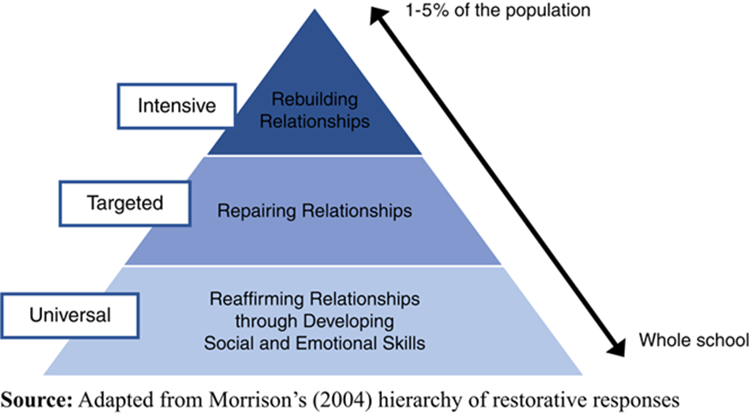
Restorative justice is not one model of practice. Restorative justice approaches are diverse and aim to address the needs of all (person responsible for the harm, persons harmed, the university community). KPU recognizes the importance of taking a “whole school approach” to implementing restorative justice rather than responding differently once the harm occurs. The whole school model developed by Dr. Brenda Morrison at Simon Fraser University encourages schools to consider how restorative justice principles can be used at multiple levels (primary, secondary and tertiary) to both prevent and respond to harm and conflict.
Primary Level: Universal – Prevent and Educate
- The primary (universal) level involves all members of the school community and is an “immunization” or “defense’ strategy so that conflict does not escalate when differences first arise. The aim is to develop and affirm each member of the school communities social and emotional competencies (Morrison, 2007, p. 107).
- The primary (universal) level also involves building relationships and addressing protective factors to create connection, resilience and health. Initiatives at this level seek to identify and transform the social conditions and institutional policies that allow harm to take place and even become normalized.
Some examples of universal initiatives include:
- Accessible workshops for all that build social and emotional skills
- Peer to peer support networks
- Written communication and policies containing restorative language and options
- Include familiarity with restorative justice principles in key job descriptions – e.g., roles that address conflict and harm
- Form Communities of Practice
- Campus wide training of restorative justice to normalize restorative mindset, language and enquiry
- Onboarded faculty are provided access to workshops on conflict resolution skills, dealing with difficult people, stress management, emotional intelligence
- Student supports to enhance attendance and presence at school
- Emotional and mental health supports
- Financial support
- Child and/or elder care
- Physical safety (Safewalk, security, etc.)
- Student supports for academic performance
- Student supports for community conduct
- Faculty supports
- Curriculum development
- Teaching and Learning
- Restorative approaches to classroom management
- Authentic assessments
- Additional supports
Secondary Level: Targeted – Maintaining relationships and restorative culture
The secondary or targeted level often involves a small or medium sized group of the school community that has been impacted or is at a greater risk of experiencing harm or conflict. In considering what makes someone or a group “at risk,” intersectionality considerations are central. A person-centered, needs based, restorative approach means that relationships are centred during problem solving. Some examples of secondary interventions are:
- Faculty meetings and supports to identify and address at risk students (The Student Referral Program [formerly Early Alert], etc.)
- Reintegration circle following faculty, staff or student absence
- Classroom management
- Circle to discuss how to enhance equity, diversity, and inclusion on campus
- Informal resolution responses to behavioural issues
Tertiary Level: Intensive – Intervening to Rebuild relationships and Repair Harm
The tertiary level involves the participation of all those who have been affected when a harmful incident occurs. This could include a wider cross-section of the school community and even those outside the university (parents, police, etc.).
There are several well-established restorative processes that can be used to deal with more serious harms. One size does not fit all, and care must be taken that these practices are facilitated by competent trained people.
For a restorative process to move forward, there are several criteria that must be met. For most instances, the person who caused the harm must accept some level of responsibility for their actions and be open to making reparation. The needs of the persons harmed are held central. They must participate voluntarily and be provided opportunities to provide voice and choice in how the process will unfold. Community members might also be included and must be informed and prepared to ensure the process itself upholds the values of respect, honesty, accountability, and safety. All parties must be fully prepared to move forward with a restorative process which could be face-to-face dialogue or involve indirect communication.
Restorative Justice Principles
Words with an asterisk (*) have a definition in the Glossary at the bottom of this page
Restorative justice is a set of values and principles that can be applied to harm and conflict of all kinds. Utilizing restorative principles has the potential to reshape justice responses to become:
- Relationship-centred: focused on understanding and promoting just* interconnections* between individuals, groups and communities
- Comprehensive and holistic: considering the contexts and causes of harm and its impacts
- Inclusive and participatory: culturally appropriate, and trauma-informed*; attentive to the safety and well-being of participants
- Responsive: contextual, flexible in practice
- Focused on individual and collective responsibility
- Collaborative and non-adversarial
- Forward-focused: educative, not punitive*; problem-solving, preventative and proactive
-Adapted from Llewellyn, J. 2018
10 Ways to Live Restoratively
- Take relationships seriously, recognizing you are one part of a web of people, institutions, and the environment
- Be aware of the impact of your actions on others and the world around you
- Take responsibility for injuries you have caused - acknowledge and try to repair harm
- Listen to others deeply and compassionately - try to understand even when you disagree
- View conflicts in your life as opportunities
- Whenever possible, involve people in decisions that affect them
- Treat everyone with respect, including those who offend you
- Engage in dialogue with others even when that's difficult - remain open to learning from them
- Be cautious about imposing your "truths" and views on other people and situations
- Sensitively confront everyday injustices
-Adapted from Howard Zehr, Changing Lenses: Restorative Justice for Our Times, 25th Anniversary Edition and The Center for Justice & Peacebuilding Infographic
Benefits of Restorative Justice in Post-Secondary Environments
Restorative justice is important to have at universities for several key reasons:
1. Creates a More Inclusive and Respectful Campus Culture
Restorative justice emphasizes dialogue, mutual understanding, and repairing harm. This approach promotes empathy and accountability, helping to build a more respectful and inclusive environment—something especially crucial in diverse academic communities.
2. Addresses Harm More Holistically
Traditional disciplinary systems in universities are often punitive and can leave underlying issues unaddressed. Restorative justice focuses on understanding why harm occurred, what its impact was, and how it can be repaired. This can lead to more meaningful outcomes for both those harmed and those who caused harm.
3. Supports Student Development and Learning
Restorative justice aligns with the educational mission of universities by fostering personal growth, critical thinking, and ethical decision-making. It encourages students to take responsibility for their actions and to actively engage in resolving conflicts and repairing harm.
4. Reduces Recidivism and Conflict
Restorative justice processes often lead to lower rates of repeating harmful behaviour because participants better understand the consequences of their actions and are given a chance to rebuild trust. This contributes to a safer and more stable campus climate.
5. Promotes Equity
Restorative justice can help reduce disparities in disciplinary actions that disproportionately affect marginalized students. It offers a more equitable and culturally responsive approach that can align with decolonizing and Indigenizing efforts in education.
6. Builds Community
By involving all stakeholders in the process—students, staff, faculty, and sometimes even the broader community—restorative justice fosters a sense of shared responsibility and connection. This helps strengthen campus relationships and community resilience.
Restorative Justice Videos
Transforming the Criminal Justice System: Restorative Justice
Restorative Justice in Academic Integrity and Beyond

Glossary
Interconnectedness
Just
Punitive
Trauma-informed
Restorative Justice Site References
Evans, K., & Vaandering, D. (2016). The little book of restorative justice in education. Good Books.
Harris, M. K. (2004). An expansive, transformative view of restorative justice. Contemporary Justice Review, 7(1), 117–141
Llewellyn, J. (2018, May 2). Realizing the full potential of restorative justice. Policy Options. Retrieved January 28, 2026, from https://policyoptions.irpp.org/2018/05/realizing-the-full-potential-of-restorative-justice/
Morrison, B. (2007). Restoring safe school communities: A whole school response to bullying, violence and alienation. Federation Press.
Yazzie, R. (1994). Life Comes From It: Navajo Concepts of Justice (as cited in Canopy Forum, Lecture 1: Indigenous Roots of Restorative Justice
Zehr, H. (2015). Changing Lenses: Restorative Justice for Our Times, 25th Anniversary Edition. Herald Press.